
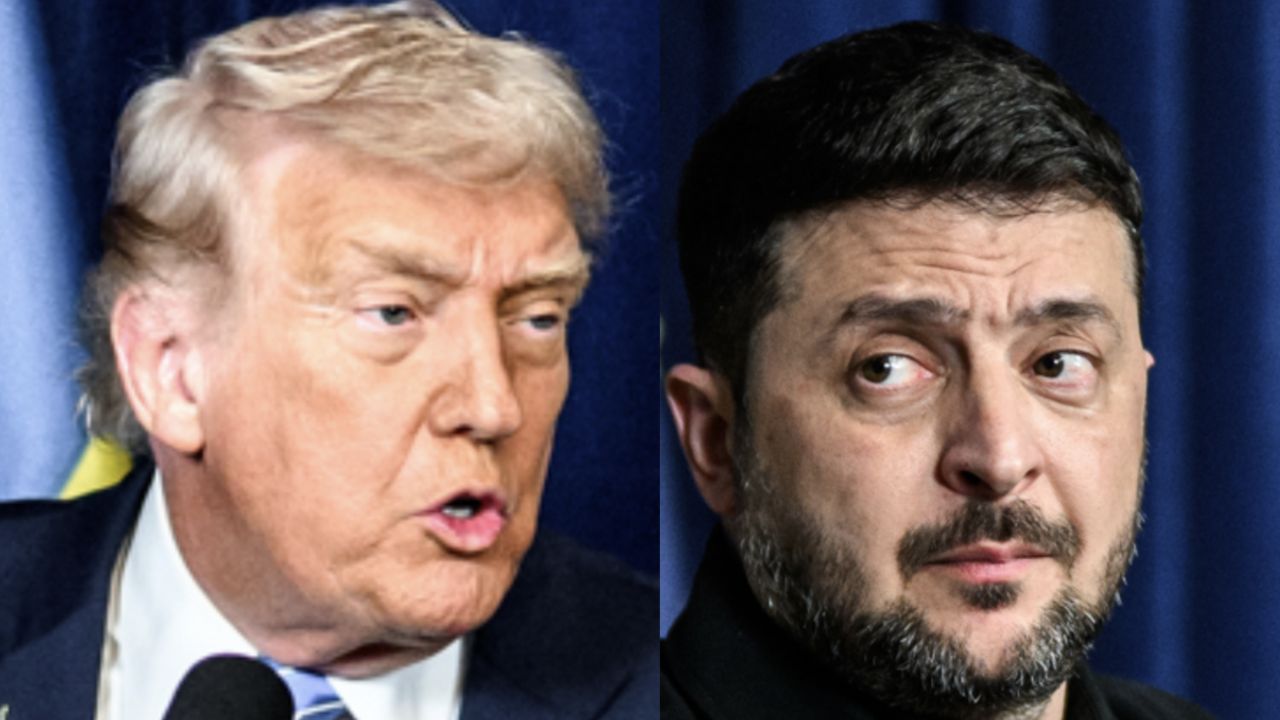
President Donald Trump on Sunday publicly called on Ukrainian President Volodymyr Zelenskyy to halt Ukraine’s long-range drone campaign against Russian oil refineries and diesel infrastructure, arguing the strikes are driving a global fuel shortage that has pushed U.S. diesel prices to record highs. The remarks, delivered from the sidelines of the Irish Open at Trump’s Doonbeg golf club, mark one of the most direct public rebukes Trump has issued to Zelenskyy since the war entered its fifth year, and they land as American voters head toward November’s midterm elections already squeezed by rising fuel costs.
Trump was asked by a reporter whether he had spoken with Zelenskyy following his recent conversation with Russian President Vladimir Putin. Rather than answering directly, Trump used the moment to call on Kyiv to change its targeting strategy. “Mr. Zelenskyy has to do one thing. He has to stop knocking out diesel fuel in Russia,” Trump told reporters. “We spoke to Mr. Zelenskyy about it. There are plenty of other targets. Don’t hit diesel fuel, because that’s hurting, that’s hurting the world,” he said.
Trump’s comments came two days after the U.S. national average price for diesel — the fuel that powers trucks, trains, ships and farm equipment — climbed past $6 a gallon for the first time, according to price tracker GasBuddy. The national average diesel price rose over $6 a gallon for the first time on Thursday, according to GasBuddy.
Ukraine has for months waged an escalating campaign against Russia’s oil and gas sector using long-range drones, a strategy Kyiv frames as legitimate given Moscow’s dependence on energy exports to bankroll its invasion. Ukraine has carried out more than 60 strikes on at least 24 Russian refineries, an effort aimed at raising the economic cost of the war for Moscow. The sustained pressure has forced widespread fuel rationing inside Russia and prompted the Kremlin to ban diesel exports in July, pulling supply from an already tight global market. Russia has since extended that export ban through the end of September as fuel shortages and long lines at filling stations persist in Russian cities.
The global diesel crunch, however, is not solely a product of the Ukraine war. According to a report published Friday by the International Energy Agency, net exports of diesel and gasoil from Gulf countries in August stood at just over a quarter of pre-war levels, following the disruption of oil shipments through the Strait of Hormuz tied to the U.S. war against Iran. “Disruptions to Russia’s refining system and a near-halt to product exports following intensified Ukrainian attacks have compounded these losses,” the IEA wrote, noting that in February, combined diesel and gasoil exports from the Gulf and Russia accounted for almost 45% of global seaborne trade.
The diesel dispute surfaces a notable reversal in Trump’s posture toward Ukraine’s energy strikes. Roughly a year earlier, Zelenskyy had said Trump personally endorsed Kyiv’s retaliatory attacks on Russian energy infrastructure. “If they attack our energy, President Trump supports that we can answer on energy,” Zelenskyy said in an interview released in September 2025. Sunday’s remarks suggest that tolerance has narrowed considerably as the diesel strikes’ global spillover has become harder to ignore politically.
Zelenskyy, for his part, has continued to defend the refinery campaign as a proportional response to Russia’s own strikes on Ukrainian energy infrastructure. “If they cause us blackouts, we will try to respond to them in kind,” Zelenskyy said, defending Ukraine’s continued targeting of Russian energy facilities. The exchange underscores the gap between Washington’s economic concerns and Kyiv’s view of the refineries as legitimate wartime leverage.
The diplomatic backdrop to Trump’s comments includes a fresh round of shuttle diplomacy. U.S. envoys Jared Kushner and Steve Witkoff held talks with Putin in Moscow last weekend, followed by a meeting with Zelenskyy in Kyiv. Despite that outreach, the core demands of Moscow and Kyiv remain mutually exclusive, particularly over territorial concessions. Separately, Kushner has said Ukraine’s unwillingness to cede territory continues to stall a broader peace deal.
Overnight Strikes Hit Russian Refineries in Tatarstan and Krasnodar
Ukraine’s refinery campaign continued even as Trump spoke. Two Russian civilians were killed and 14 others wounded after a drone struck near a parked car in Nizhnekamsk, a city in Russia’s Tatarstan region that houses a major cluster of oil refineries and petrochemical, rubber and polymer plants. Local officials, including regional head Rustam Minnikhanov and Nizhnekamsk Mayor Radmir Belyaev, confirmed the strike and said a fire had broken out at an unspecified “enterprise” in the city.
Ukraine’s Defense Intelligence agency also claimed to have struck a major oil refinery in Slavyansk-on-Kuban, in Russia’s Krasnodar region near Crimea, hitting a key oil processing unit and the facility’s tank farm overnight into Sunday. Krasnodar regional authorities said the strike injured three people and damaged an oil pipeline. Russia’s Defense Ministry said its forces shot down 389 Ukrainian drones over the course of the night.
Russia Pounds Odesa and Western Ukraine Near NATO Border
Russia answered with its own large-scale drone campaign. At least nine people were injured in what Serhii Lysak, a member of Odesa’s military administration, described as a “massive” nighttime attack on the city, home to Ukraine’s main Black Sea port hub. The strike followed a Saturday drone attack that hit a residential high-rise in Odesa, killing two people and injuring 26 others, according to Ukrainian officials. Kyiv has repeatedly accused Moscow of trying to choke off Ukraine’s maritime exports through the sustained bombardment of the port.
Russian strikes overnight also reached western Ukraine, close to the borders of NATO member states. One drone set fire to a gas station near the Yahodyn-Dorohusk border crossing with Poland, according to Ukraine’s foreign minister and a spokesperson for the local customs service. Ukrainian Foreign Minister Andrii Sybiha condemned the strike in stark terms: “This is Putin’s terror ‘knocking’ directly on the doors of the EU and NATO. Russian barbarians are at your gate, dear partners,” he wrote on social media platform X.
Valentyna Chernysh, a spokesperson for the Volyn Customs Office, told The Associated Press that the Yahodyn crossing itself remained intact and that no one was harmed in the incident. The crossing, along with others on Ukraine’s western border, serves as a critical conduit for Western military and humanitarian aid flowing into the country. Earlier in the week, two people were killed when Russian drones struck the Starokozache border crossing between Ukraine and Moldova, and Polish Prime Minister Donald Tusk said a separate “direct threat” to a Polish-Ukrainian crossing point was averted through coordination between Warsaw and Kyiv.
Ukraine’s air force reported shooting down or suppressing 409 of the 453 Russian drones launched overnight, including a newer jet-powered variant that flies faster and is more difficult for air defenses to intercept. The intensifying drone exchanges come as Russia has ramped up its aerial campaign against Ukraine’s power grid in recent weeks, using ballistic missiles alongside drones in what Ukrainian officials describe as an effort to demoralize the civilian population ahead of winter.
International Mediation Offers Emerge as Talks Stall
The dispute over diesel strikes has unfolded alongside renewed international interest in brokering an end to the war. During a meeting on the sidelines of the BRICS Summit in New Delhi, Indian Prime Minister Narendra Modi and Chinese President Xi Jinping told Putin that India and China are prepared to mediate and help end the conflict. Kremlin spokesman Dmitry Peskov said Putin welcomed the offer from the two leaders. Whether that outreach gains traction remains unclear, particularly given the unresolved territorial disputes that have stalled U.S.-brokered talks.
For now, the immediate flashpoint remains the diesel campaign itself. Trump’s public pressure on Zelenskyy signals a White House increasingly focused on the domestic economic fallout of a war it has struggled to bring to a close, even as Kyiv shows no indication it intends to abandon a strategy it views as one of its few effective points of leverage against Moscow.