
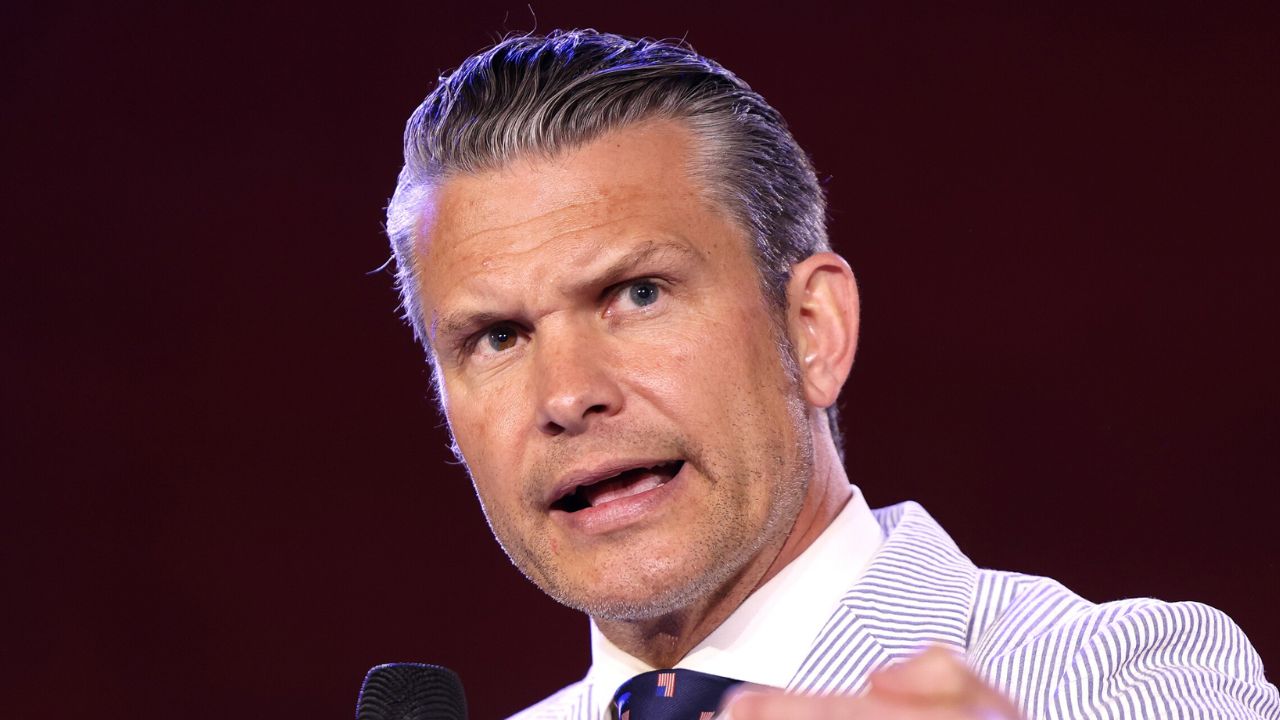
Standing before survivors and family members of the September 11th attacks at the Pentagon on Friday, Secretary of War Pete Hegseth delivered a stark message about the future of American conflict: there will be no end to it, and a new generation of troops must be raised to meet it.
The remarks came during the Pentagon’s ceremony marking the 25th anniversary of the attacks that killed 184 people at the building and nearly 3,000 Americans nationwide. President Donald Trump, Chairman of the Joint Chiefs of Staff Gen. Dan Caine and former Secretary of State Condoleezza Rice were among those present as Hegseth moved from a recounting of the day’s history into remarks about the war against Iran and what he framed as the permanent nature of conflict itself.
“But we also know, as Scripture says, the world will always have war and rumors of war,” Hegseth told the crowd. “And so the fight goes on. And so we raise up a new generation of strong, brave warriors who will say, ‘When it matters most, send me.’ Or as they said on Flight 93, Todd Beamer’s favorite famous words, ‘Let’s roll.’ The top 1% of Americans, those that wear the uniform, still keep the watch. We all sleep in peace because we know they stand ready.”
The line “wars and rumors of wars” comes from the Gospel of Matthew, chapter 24, in which Jesus warns his disciples that such conflict is inevitable but not itself a sign that the world is ending. The verse has been widely cited throughout history during moments of geopolitical anxiety, typically invoked to argue that ongoing conflict, however alarming, does not represent a unique historical crisis but rather a permanent feature of a fallen world. Hegseth’s use of the phrase Friday framed the six-month-old war with Iran, and whatever conflicts follow it, as part of that same unbroken continuum rather than an aberration.
His reference to “send me” echoes a line from earlier in the same speech, where Hegseth cited the Book of Isaiah’s account of the prophet answering God’s call with the words “Here I am, Lord. Send me.” Hegseth had used that same verse to describe the wave of Americans who volunteered for military service after the original September 11th attacks, and he closed his remarks by applying the same phrase forward, to a rising generation of troops who have “not even been born yet” when the towers fell.
The invocation of Todd Beamer’s “Let’s roll” places Hegseth’s remarks squarely within a long American tradition of commemorating September 11th through the passengers of United Flight 93, who stormed the cockpit of their hijacked plane before it could reach Washington, D.C., crashing instead into a field near Shanksville, Pennsylvania. Beamer, a passenger on the flight, was recorded saying the phrase to fellow passengers moments before they moved to retake the aircraft, and it has since become shorthand in American political and military rhetoric for decisive, self-sacrificing action in the face of an attack.
Hegseth’s claim that “the top 1% of Americans” wear the uniform reflects a commonly cited, if rough, estimate of the share of the U.S. population currently serving in the armed forces. With roughly 1.3 million active-duty personnel out of a U.S. population of more than 335 million, the actual figure is closer to a few tenths of one percent — smaller than “1%” but consistent with the broader point Hegseth was making about how small a slice of the country carries the burden of military service relative to the rest of the population that benefits from it.
The “peace through strength” framing embedded in Hegseth’s remarks tracks with statements he has made publicly for years before becoming secretary of war. Hegseth has previously argued that peace through strength works, while war is instead invited by weakness — a formulation that positions continuous military readiness, rather than diplomacy or restraint, as the primary deterrent against future attacks.
Friday’s remarks arrived with the war against Iran, launched under the name Operation Epic Fury on February 28, 2026, now in its seventh month following the breakdown of several rounds of peace negotiations. Hegseth’s suggestion that “the fight goes on” indefinitely comes as the war remains active despite an earlier ceasefire and diplomatic framework reached in the spring, underscoring his point that even negotiated pauses do not represent an end to conflict, only an interval within it.
The rhetorical style on display Friday — blending Scripture, pop-history references and military messaging — has become a recognizable feature of Hegseth’s public communications since the war with Iran began. NPR’s national security desk has noted that Hegseth’s wartime briefings have regularly closed with prayer and have incorporated elements, including cartoon memes released alongside footage of strikes on Iranian targets, that reporters covering the Pentagon for decades say have no clear precedent in prior administrations’ war briefings.
The ceremony itself continued after Hegseth’s remarks with a rendition of “America the Beautiful” performed by the President’s Own Marine Band, followed by a benediction from the military’s chief chaplain, Maj. Gen. Trent Davis, who prayed for attendees to depart “strong and courageous” and “fiercely resolved” to defend the country — language that echoed Hegseth’s own call to raise up a new generation of “strong, brave warriors.”
Trump, who spoke before Hegseth, kept his own remarks closer to a traditional commemorative register, focusing on the victims of the 2001 attacks and the unity that followed, according to accounts of the ceremony, while briefly connecting the war on terror to the current Iran campaign by pledging that service members were working “right now” to ensure Iran never obtains a nuclear weapon.
For the survivors and family members in the Pentagon courtyard Friday — many of whom lived through the actual attack a quarter-century earlier — Hegseth’s message doubled as both remembrance and recruitment: an assertion that the war that began on their darkest day never fully ended, and that its next chapter will be carried by Americans not yet born when the first one began.