
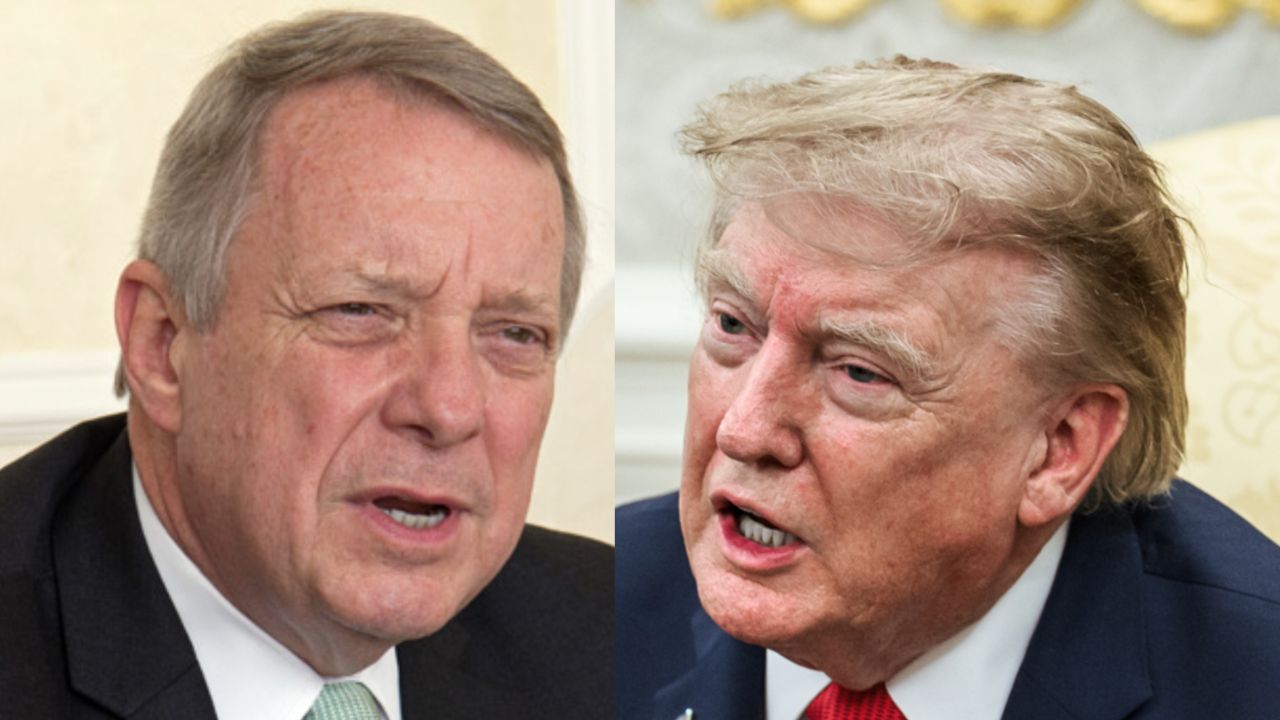
U.S. Senate Democratic Whip Dick Durbin (D-IL) on Friday accused President Donald Trump of driving American fuel prices to an unprecedented level, tying the record cost of diesel directly to the ongoing U.S. war with Iran and what he described as the administration’s erratic approach to foreign policy. The senator’s remarks, posted to X shortly before mid-afternoon, arrived hours after government data confirmed that diesel had crossed $6 per gallon nationally for the first time in U.S. history, a threshold that has intensified economic anxiety just weeks before the November midterm elections.
Durbin’s Post in Full
Durbin published his statement on X at 3:26 p.m. on September 11, 2026, writing in its entirety:
“Diesel prices hit $6 per gallon for the first time in history thanks to Trump’s war with Iran. It’s been six months and we’re no closer to an end to this conflict. Trump’s chaotic foreign policy is alienating key allies and costing Americans more every day at the store and the pump.”
Responding to a Record-Breaking Report
Durbin’s post came in direct response to an Associated Press report published Friday morning documenting that the national average price of diesel had climbed to nearly $6.06 per gallon, up from $5.85 the previous week and $3.71 a year earlier, according to data from motor club AAA. The AP reported that diesel prices have risen more than 60% since the U.S. and Israel launched their war against Iran in late February, when the national average sat at roughly $3.76 per gallon.
Crude Oil Surges Past $100 a Barrel
The AP report tied the diesel spike to renewed volatility in global crude markets, noting that both Brent crude, the international benchmark, and U.S. crude surpassed $100 a barrel this week for the first time in months as fighting between the United States and Iran escalated again. Regular gasoline also climbed to nearly $4.30 a gallon nationally on Friday.
Trump Signals Prices Won’t Ease Before Midterms
According to the AP, Trump has repeatedly sought to minimize the economic fallout from the war he co-launched, telling reporters that oil prices are unlikely to fall until after November’s midterm elections. That timeline has fueled Democratic criticism that the administration lacks a clear strategy for ending the conflict even as its financial toll on households continues to mount.
Supply Disruptions Compound the Crisis
The International Energy Agency reported Friday that Saudi oil production fell to a three-decade low last month due to Houthi attacks on energy facilities, while Russia’s refining system has been nearly halted by Ukrainian strikes. Tanker traffic through the Strait of Hormuz, a critical corridor for global oil shipments, has also slowed dramatically, with Kpler data showing daily transits falling from roughly 125 to 140 before the war to as few as 10 in recent weeks.
Not Durbin’s First Warning on the War
Friday’s post continues a pattern of public criticism Durbin has leveled at the administration since the war began. When the U.S. and Israel first struck Iran on February 28, Durbin warned that “the rash and unpredictable conduct of President Trump is a well-established worry in many ways but an impulsive commander in chief is a deadly combination,” adding that he was one of 23 senators who voted against the Iraq War and saw echoes of that conflict in the new campaign.
Five Days, Five Explanations
Days into the conflict, Durbin took to the Senate floor to accuse the White House of shifting its justification for the war multiple times. “Well, we’re in the fifth day of this war and so far, we have five different explanations from the White House as to why we invaded Iran,” Durbin said, later adding, “So, Israel is dictating America’s foreign policy?” in reference to one of the administration’s stated rationales. He urged colleagues to support Senator Tim Kaine’s War Powers resolution aimed at blocking further unauthorized strikes.
Pressing the Pentagon on Costs and Casualties
By late July, with the war well into its fifth month, Durbin used a Senate Appropriations Committee hearing to challenge Defense Secretary Pete Hegseth over the war’s financial toll, saying the Pentagon had requested an additional $88 billion in supplemental funding despite already holding more than $75 billion in unspent money. Durbin noted that Hegseth had estimated the war’s cost at $37.5 billion but said that figure excluded repairs to damaged U.S. bases in the Middle East and did not account “to say nothing of the cost to our service members … or most importantly, of the 18 brave Americans that have been tragically killed.”
Grocery and Household Costs Climbing
The economic strain Durbin referenced Friday extends well beyond the pump. The AP noted that fuel accounts for roughly 15% to 30% of the total cost of food, according to the Independent Grocers Alliance, meaning higher diesel prices tend to filter into grocery bills over time. Michigan State University food economist David Ortega told the AP that perishable goods requiring refrigeration are typically the first to see price increases, with July seafood prices up 7% and fresh fruit up 4.9% year-over-year.
Surcharges Already Hitting Consumers
Several major shippers have already responded to rising fuel costs with new fees. Amazon introduced a temporary 3.5% fuel and logistics surcharge on some third-party sellers in April, while UPS, FedEx and the U.S. Postal Service added their own surcharges earlier in the war, citing escalating fuel expenses.
A Global Problem, Felt Unevenly
The pain is not confined to the United States. Citing Global Petrol Prices data, the AP reported that diesel prices in Nigeria have surged more than 90% since late February, followed by increases of nearly 87% in Indonesia and 80% in Lebanon, with experts warning that African and Asian nations reliant on Middle Eastern imports have been hit hardest by the disruption.
No Return to Normal in Sight
S&P Global Energy said this week that it no longer expects Middle East crude production to return to prewar levels by the end of 2027. “The market is not returning to calm, it is adjusting to the new normal,” said Jim Burkhard, the firm’s vice president and global head of crude oil research, pointing to ongoing security and logistical constraints on oil flows.
Voters Weigh In as Midterms Approach
The record diesel price arrives as polling shows deepening public frustration with the war’s economic consequences. A recent NBC News poll found that roughly 70% of voters disapprove of Trump’s handling of the Iran conflict, a finding that comes as Republicans gathered in Dallas this week for what Trump has described as a midterm election convention.
Six Months In, No Resolution
Durbin’s characterization of the war as showing no signs of ending aligns with assessments from economists tracking the conflict’s toll. KPMG chief economist Diane Swonk told reporters that the cost of diesel “gets into just about everything,” from farm operations to food prices to nearly every shipped good, and predicted the fuel’s elevated cost will remain “an inflationary problem” for months to come as the war continues without a clear resolution in sight.