
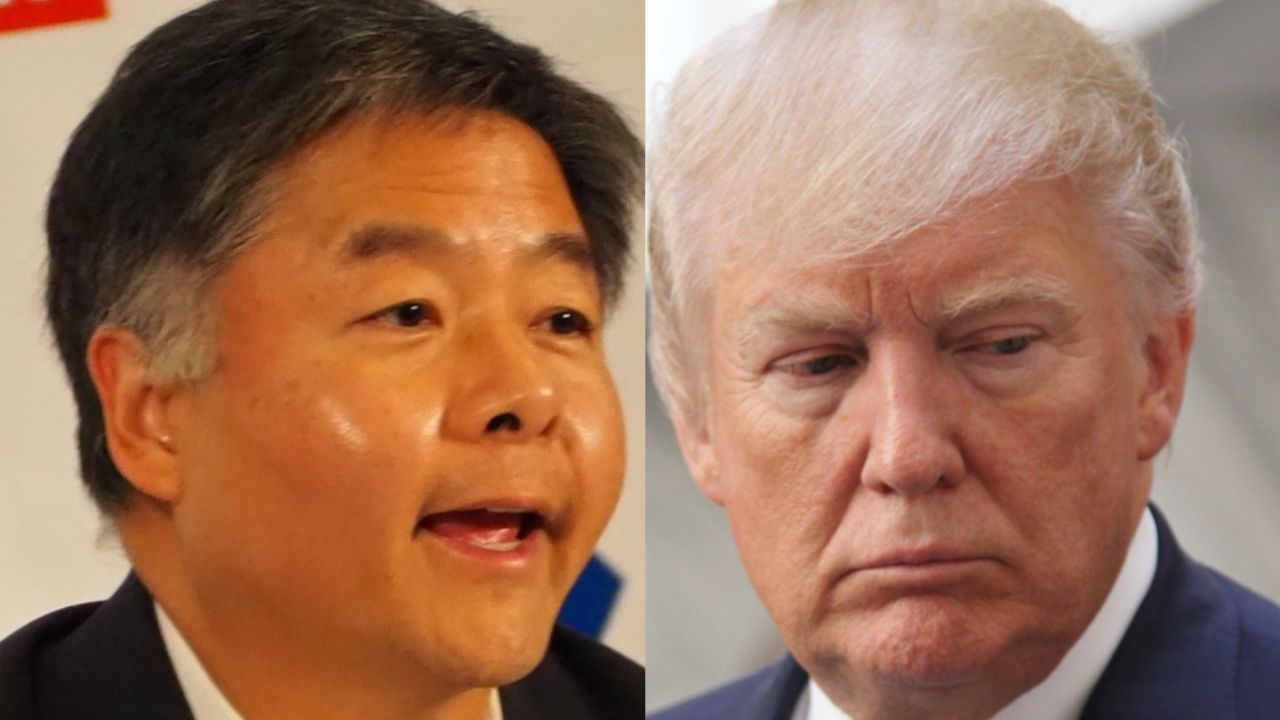
Representative Ted Lieu, a California Democrat, used a Tuesday morning X post to accuse President Donald Trump of ignoring the rising cost of living in favor of a symbolic rebranding push targeting one of the Great Lakes, warning that the political consequences would arrive with the November midterm elections.
Lieu’s post, published at 10:52 a.m. ET on August 25, 2026, read in full:
“-Gas prices are up.
-Grocery prices are up.
-Utility prices are up.
What is trump focused on? Changing the name of Lake Ontario to Lake America.
November is coming.”
The post was a direct response to a Truth Social message Trump had published roughly five hours earlier, at 5:58 a.m. that same day. Trump wrote: “The United States is giving serious consideration to changing the name of Lake Ontario to Lake America in that we don’t expect to be doing much business with Ontario any longer. Thank you for your attention to this matter! President DONALD J. TRUMP.” (
Trump followed his initial post with a separate image on the platform depicting a map with “Lake Ontario” crossed out and replaced with “Lake America” in gold lettering alongside an American flag graphic. Later Tuesday morning, Trump escalated his rhetoric further, calling Canada “entitled” and “unreasonable” and accusing the country of having “ripped off” the United States for decades.
The Lake Ontario proposal did not emerge in isolation. It followed a sharp breakdown in trade negotiations between Washington and Ottawa. On Saturday, the United States began imposing 50% tariffs on hundreds of Canadian goods after negotiators failed to reach an agreement, and Canadian Prime Minister Mark Carney responded by promising retaliatory tariffs of his own. On Monday, Trump also announced a 50% tariff on all Canadian automotive and steel imports set to take effect in January.
The dispute took on a more personal dimension in the days before Trump’s Lake Ontario post. Ontario Premier Doug Ford told the president he could “kiss my ass” during a Monday exchange, prompting Trump to refer to Ford as “Flunky Ford” and to describe both Ford and Carney as “clowns” in subsequent Truth Social posts.
Canadian officials pushed back on the renaming proposal within hours of Trump’s post. Industry Minister Mélanie Joly told reporters Tuesday, “We’ll always call it Lake Ontario,” adding that Canada intended to respond strategically rather than react to what she called political theater.
The proposal is not the first time Trump has floated changing the name of a prominent geographic feature during his second term. In 2025, he ordered federal agencies to adopt “Gulf of America” in place of the Gulf of Mexico and restored “Mount McKinley” as the federal name for Alaska’s Denali, reversing a change made under the Obama administration. He has also used provocative place-naming as a political statement in other contexts, including an image shared earlier this month depicting the Strait of Hormuz under a different name.
Lieu’s post also arrived against a backdrop of measurable increases in household costs. According to Bureau of Labor Statistics data published August 12, 2026, the average price of gasoline rose 24.6% over the 12 months ending in July, following a 26.7% annual increase reported the month before. Separately, the national average price at the pump stood at $4.14 per gallon as of August 20, 2026, up from $4.09 the previous week.
The broader Consumer Price Index report released by the Labor Department on August 12 showed food and shelter costs continuing to climb, even as the headline monthly inflation rate came in at 0.1% for July. Grocery prices, utility rates and shelter costs were all cited as continuing pressure points for household budgets heading into the fall.
Tuesday’s post fits a pattern Lieu has repeated throughout 2026, pairing rising cost-of-living data with criticism of the administration’s public focus. In May, he wrote on X, “‘I don’t think about Americans’ financial situation.’ -trump. November is coming,” quoting a diesel price report showing record highs in Michigan, Indiana, Wisconsin and Illinois. In July, he wrote that the administration was “jacking up energy costs even more by reducing supply,” again closing with “November is coming.” Just days before Tuesday’s post, Lieu had criticized the administration for what he called a focus on “putting Trump’s name on airports,” “putting Trump’s name on buildings” and “putting Trump’s name on coins” instead of addressing costs.
The “November is coming” refrain refers to the 2026 midterm elections, scheduled for November 3. Trump has repeatedly predicted a Republican victory in the midterms, even as multiple Republican figures have raised concerns about his standing with voters. Former New Jersey Governor Chris Christie has pointed to Trump’s declining approval ratings, including a rating of minus-45 among independents, as a factor that could push vulnerable Republican candidates to distance themselves from the president ahead of the election.
Other Democratic officials have echoed Lieu’s criticism of the Lake Ontario proposal specifically. Michigan Democratic Party chairman Curtis Hertel Jr. said Trump’s push to change the lake’s name undercut his own economic promises, arguing the president had failed to deliver on commitments related to prices, wages and avoiding new conflicts abroad.
Trump’s Lake Ontario comments came one day after he announced the increased automotive and steel tariffs against Canada, which are scheduled to take effect January 1, 2027, and after he stated that Canada “will be treated like a state no longer.” The trade dispute has continued without resolution, with Canadian officials, including Minister for Canada-U.S. Trade Dominic LeBlanc, declining to respond directly to the president’s social media posts and instead emphasizing a focus on strengthening Canada’s own economy.
As of Tuesday afternoon, the White House had not issued a formal proposal or executive order regarding a Lake Ontario name change, and the idea remained, as Trump himself described it, under “serious consideration.” Whether the dispute over the lake’s name becomes a lasting flashpoint in the broader U.S.-Canada trade standoff, or fades as quickly as it emerged, is likely to depend on the trajectory of negotiations between Washington and Ottawa in the weeks ahead.