
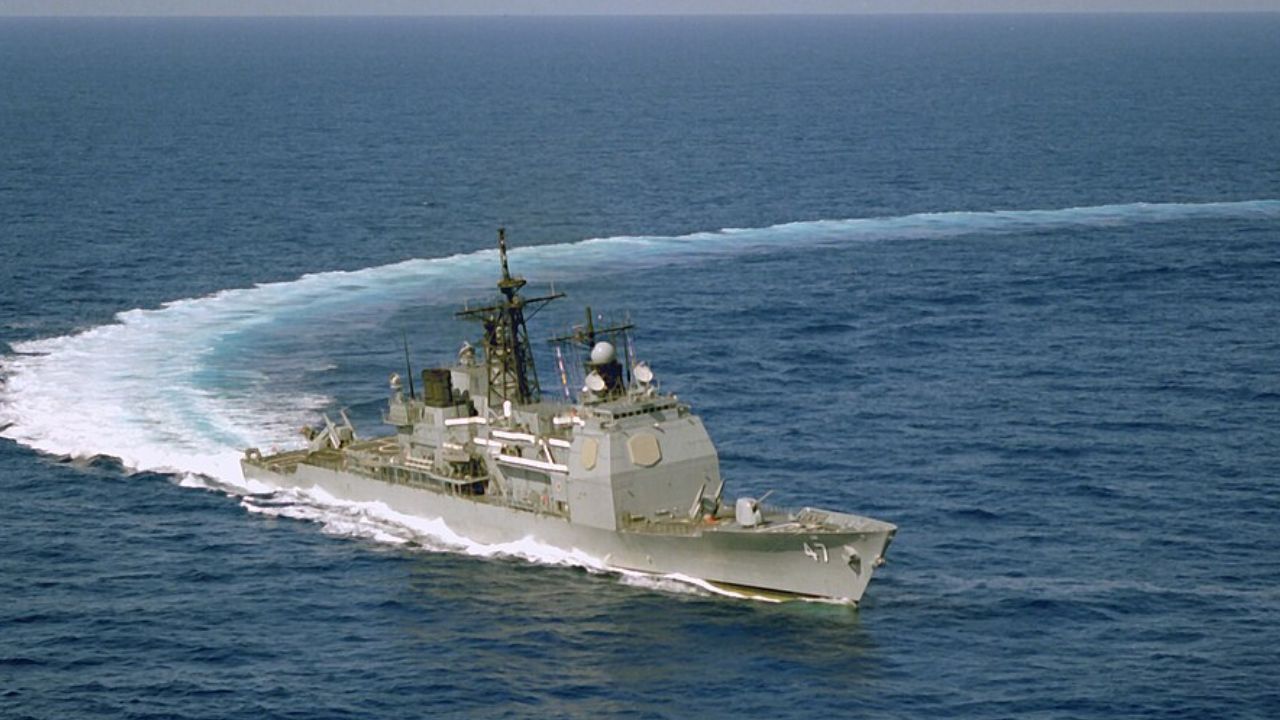
The U.S. Navy’s guided-missile cruisers didn’t evolve in a neat, linear march from “bigger destroyer” to “bigger destroyer with better radar.” They evolved because threats advanced faster than hulls could, and because the fleet needed a surface combatant that could do two demanding jobs at once: defend other ships against intense air attack and serve as a command-and-control focal point during complex engagements. From early Cold War conversions to the Aegis-equipped Ticonderoga-class (CG-47), the cruiser story is ultimately about integrating sensors, weapons, and networks into a system built for fast decision-making under pressure.
That history matters today as the Navy retires aging cruiser hulls while facing harder questions about integrated air and missile defense (IAMD), ballistic missile defense (BMD) capacity in certain configurations, and how carrier strike groups and distributed surface forces operate under sophisticated raid threats. There is no single “replacement cruiser” to plug into the force. Instead, the Navy is shifting functions across destroyers, networks, and joint/coalition architectures—while future large surface combatant concepts remain more planned than fielded.
From conversions to purpose-built missile command ships
The first guided-missile cruisers grew out of Cold War urgency: the Navy needed missile capability at sea quickly. Converting existing hulls into missile-armed ships was a practical way to field new weapons without waiting for entirely new designs. Those conversions were not simply a hardware swap. They forced changes in how surface ships detected threats, controlled fires, and operated at a faster engagement tempo than gun-era air defense had demanded.
As the air threat became more capable, the requirement shifted from “can we defend the formation?” to “can we sustain defense against coordinated attacks while keeping the force organized?” That pushed cruisers toward larger command spaces, stronger communications, more capable sensors, and combat systems built to manage multiple engagements. Even before Aegis, the cruiser identity was forming around a dual purpose: fight and coordinate at the same time.
Why Aegis was the inflection point
If early missile cruisers were about getting missiles to sea, Aegis reshaped how naval air defense was conducted. The Aegis combat system integrated radar, command-and-control, and weapons control into an architecture designed for rapid, complex engagements—the kind of scenario a carrier strike group must plan for when multiple threats appear nearly at once. Put simply, Aegis made the combat system act like an integrated whole rather than separate components working in sequence.
That shift fits the reality of modern air defense: it is less about a single intercept and more about managing a continuous problem—ambiguous tracks, short decision windows, and threats arriving from different directions and altitudes. Aegis-equipped ships, and especially the Ticonderoga-class cruisers, became central to high-end air-defense battle management. Their value was not only what they could shoot, but how well they could build the picture and coordinate engagements while still fighting their own ship.
VLS: the enabler for multi-mission cruisers
The other major leap was the Vertical Launch System (VLS), which made missile capacity and flexibility a tactical advantage. Rather than relying on a small set of dedicated launchers tied to specific weapon types, VLS allowed a cruiser to carry a mix of missiles for air defense, land attack, and other missions within a common launching architecture. The point is not a particular loadout; it is the ability to tailor capability to the mission and the threat.
VLS also tied combat power more directly to logistics and procurement realities. Flexibility at sea still depends on what the Navy can buy, stockpile, and move—what is available, where it can be loaded, and how quickly inventories can be replenished. In that sense, the cruiser’s multi-mission identity is as much a sustainment story as a tactical one.
What makes a cruiser different from a destroyer?
In U.S. Navy practice, the difference has often been more about roles than labels. Cruisers have historically been associated with high-end air defense for carrier strike groups and with command-and-control functions—managing the air picture and coordinating layered defenses when the force needs a dedicated battle-management hub. Destroyers have long contributed to the same missions, and in later generations often with closely related combat systems. But cruisers have been the archetypal “air-defense centerpiece” within the strike group construct.
That line has blurred as Aegis became widespread and as modern destroyers adopted comparable networks, sensors, and launch capacity. In many cases, what matters operationally is whether a ship brings the right combination of sensors, battle-management tools, trained watch teams, and weapons inventory for IAMD—not the hull classification. The cruiser legacy still matters because it reinforced an enduring requirement for surface forces: coordinating the fight is inseparable from fighting it.
Mission growth: from air defense to IAMD and beyond
As threats diversified, cruiser missions expanded beyond air defense into broader sea control, strike, and integrated operations. With Aegis as the core enabler, cruisers increasingly represented a “system-of-systems” approach—connecting sensors, weapons, and offboard data to build a coherent picture and support complex engagements. The underlying lesson is that modern maritime combat is a networked fight, not a single-platform duel.
For some configurations, ballistic missile defense also became part of the mission set as the Navy sought flexible ways to contribute to wider theater and national defense requirements. That capability can be strategically valuable, but it also comes with practical tradeoffs in training, maintenance, and availability. High-end capability is not just a feature of the ship; it is a demand on readiness and planning.
The Indo-Pacific problem set: complex raids and the premium on coordination
In today’s environment, naval planners often focus less on isolated attackers and more on complex raids that stress sensors, decision-making, and magazine depth. The strategic relevance of cruisers—and of the Aegis/VLS model they exemplify—is that they were designed to manage complexity: many tracks, uncertain identification, and engagement coordination across ships and aircraft. Advanced threats, including faster and more challenging attack profiles, add urgency, but they do not change the basic requirement: detect, decide, and engage in time, repeatedly.
This is also why “distributed” operations do not eliminate the need for strong command-and-control. Distribution can spread risk and complicate an adversary’s targeting, but it can also increase coordination demands—more nodes, more data, and more opportunities for friction. The cruiser lineage highlights a recurring reality: networking enables, but trained battle management decides outcomes.
Aging hulls, modernization limits, and the retirement debate
Today’s cruiser debate is shaped as much by force-structure and readiness constraints as by tactics. The Ticonderoga-class retains a powerful set of capabilities, but aging hulls and modernization limits have driven difficult choices about cost, shipyard time, and how long the ships can remain viable. Each major maintenance period is a tradeoff: resources devoted to sustaining legacy hulls are not available for other needs, yet retiring ships too quickly can strain near-term capacity.
Public discussion can slip into extremes. Retiring cruisers does not automatically mean a carrier strike group is left “undefended”—destroyers and other assets contribute significantly, and the Navy’s defensive approach is layered. The more grounded implication is about capacity and flexibility: if ships optimized for high-end air defense and command-and-control leave service faster than their functions are absorbed elsewhere, commanders may face tighter schedules, fewer surge options, and less margin for training and maintenance.
Who’s involved: fleet operators, shipyards, and the combat-system ecosystem
The cruiser story has always been shaped by a three-part engine: operational requirements defined by fleet operators, construction and maintenance performed by U.S. shipyards, and combat-system integration supported by the broader Aegis and weapons-integration ecosystem. Even when the hull design is mature, the combat system’s relevance depends on continuous updates—software, sensors, networking, and weapon compatibility. That creates enduring industrial demand centered on modernization and sustainment as much as new construction.
As cruisers age out, that workload shifts rather than disappears. More pressure moves to maintaining and upgrading other Aegis-capable ships, supporting training pipelines, and keeping launch systems and missile inventories ready. A recurring constraint is shipyard capacity and scheduling: readiness depends not only on what the fleet owns, but on how reliably it can move ships through maintenance on time.
What changes next: filling the “cruiser role” without building a cruiser
The Navy is moving toward a force where the “cruiser role” is spread across platforms and networks rather than concentrated in a new class of guided-missile cruisers. In practice, that means destroyers taking on more of the carrier-defense and IAMD workload, with joint and coalition assets contributing to a wider integrated air and missile defense picture. It also raises the importance of connectivity and battle management—distributed capability only matters if it can be coordinated under stress.
Concepts for future large surface combatants continue to shape the broader “next-gen” discussion, but they should be treated as plans and ambitions unless and until they are backed by clear, fielded programs. The near-term reality is a transition: fewer cruisers, heavier reliance on other Aegis-equipped combatants, and a premium on readiness, inventory, and training. The throughline of the cruiser’s evolution—from conversion, to Aegis integration, to VLS-enabled flexibility—is a useful guide for what comes next: the decisive advantage is not the label on the hull, but the ability to integrate systems and fight as part of a coordinated force.