
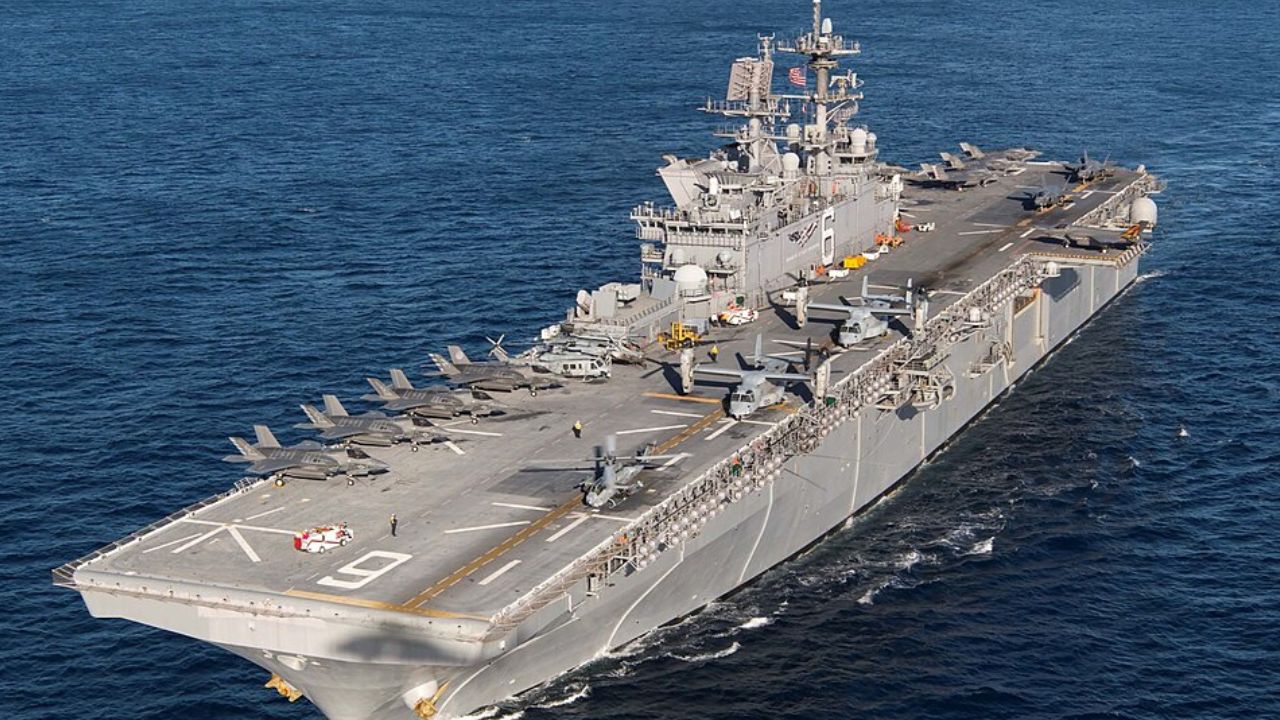
America’s big-deck amphibious assault ships were not designed to be “mini aircraft carriers” in the way the term is often used today. They became increasingly aviation-centric over decades as the U.S. Navy and U.S. Marine Corps adapted how Marines get ashore—and, just as importantly, how they can operate without needing established bases on land. The ships now most associated with that evolution, the LHA and LHD “big-deck amphibs” (including the Tarawa-, Wasp-, and America-class), reflect a steady shift from primarily surface-delivered landings toward sea-based aviation that can support helicopters, STOVL jets, and traditional landing craft operations depending on mission and configuration.
That history matters because it helps explain why amphibs remain a core tool of U.S. power projection. Big-deck amphibs are routinely discussed in the context of crisis response, raids, evacuations, humanitarian assistance/disaster relief, and—when required—forcing entry. Their flexibility also feeds an ongoing debate about how best to employ them in great-power competition, particularly in the Indo-Pacific: what roles make sense in contested environments, how survivable large amphibs are against modern anti-ship threats, and how they should complement aircraft carriers and more distributed force designs.
From “get to the beach” to “go over the beach”
In World War II, U.S. amphibious warfare emphasized moving large formations and heavy equipment to a defended shoreline and pushing inland from a beachhead. That approach shaped ships and doctrine around the practical requirements of landing and sustaining troops under fire. Aviation supported amphibious operations, but it was not the organizing principle for amphibious ship design.
After the war, helicopters began changing the geometry of amphibious assault. Vertical lift made “vertical envelopment” possible: moving Marines over the surf line and around obstacles and prepared defenses rather than concentrating everything at the water’s edge. As that concept matured, it drove interest in helicopter-centric amphibious ships (often discussed publicly as LPH), setting conditions for later designs that treated the flight deck as a primary feature rather than an add-on.
The big-deck amphib: built around aviation, still defined by amphibious missions
The modern big-deck amphib concept took clearer form with the LHA/LHD families. The Tarawa-, Wasp-, and America-class ships were designed to operate as part of a Navy-Marine Corps team: a sea base that can embark a landing force, provide command-and-control, and operate a substantial aviation detachment. In these designs, the flight deck became central because aviation was increasingly central to how Marines maneuvered and how commanders generated options from the sea.
Even so, big-deck amphibs differ from aircraft carriers by purpose and design priorities. Their value lies in combining Marines, aviation support, and—depending on class and loadout—the ability to move forces ashore using landing craft and other connectors. That is why the “mini carrier” label is both understandable and incomplete. These ships can run serious flight operations, but they are not optimized to replace nuclear aircraft carriers in sustained high-end warfare, and their aviation capacity, ordnance storage, and sortie generation are closely tied to how they are configured for a given deployment.
Harrier-era STOVL: when the amphib gained a strike option
The introduction of STOVL jets expanded what an amphibious flight deck could contribute. In the Harrier era, big-deck amphibs could support fixed-wing sorties in addition to helicopter operations, adding strike and other air contributions that could matter during contingency operations and in support of forces ashore. This did not turn LHAs and LHDs into aircraft carriers, but it broadened what an amphibious ready group could bring to a crisis without relying on nearby land bases.
It also influenced how commanders thought about presence and responsiveness. A big-deck amphib with embarked Marine aviation could reposition quickly, show visible capability, and support missions ranging from evacuation and raids to disaster relief—though the specific mix of aircraft and troops has always depended on the tasking and the environment.
F-35B and the renewed focus on aviation-heavy configurations
The arrival of the F-35B has intensified interest in the aviation-capable side of big-deck amphibs. With a modern STOVL aircraft operating from an amphibious deck, these ships can be configured to emphasize air operations in ways that resemble a limited “light carrier” role in public discussion. The important point is that this posture is a choice. Prioritizing fixed-wing aviation can affect how much capacity and readiness the ship retains for other amphibious functions, and commanders tailor that balance to the mission.
In day-to-day competition, an aviation-leaning amphib can offer a flexible sea-based air option when access to bases ashore is uncertain. In a high-end fight, the questions become sharper: survivability, how close the ship can prudently operate, and how its air operations fit alongside other naval and joint capabilities in a theater where anti-ship threats are a central planning factor.
Well decks, flight decks, and the mission-mix tradeoffs
Big-deck amphibs are asked to do many things at once: move and support Marines, enable aviation, provide command-and-control, and respond to crises. That is why debates about design features often center on the practical meaning of flight decks and well decks. A well deck supports maritime connectors and a more traditional pathway to putting forces and equipment ashore. An aviation-heavy approach prioritizes helicopters and STOVL jets that can project power inland quickly and reduce reliance on a contested shoreline.
How the United States balances those capabilities is ultimately a question of concept-of-operations as much as ship architecture. Marine Corps modernization and interest in smaller, lighter expeditionary approaches have reinforced concerns about concentration, signature, and survivability. At the same time, big-deck amphibs remain uniquely useful for missions—such as evacuations and disaster relief—where ports, runways, and local infrastructure may be damaged, unavailable, or politically difficult to access.
Great-power competition: relevance, risk, and the Indo-Pacific
The Indo-Pacific frames the argument in practical terms. Amphibious assault ships are valuable because they can operate without depending on local bases, which matters when access is uncertain or infrastructure is sparse. A sea base can reposition, adjust the embarked force, and provide options without the same footprint as building up a large presence ashore.
But the same theater highlights the risk. A big-deck amphib is a high-value asset carrying Marines and aviation; losing one would have serious operational and strategic consequences. That reality helps drive interest in distributed approaches meant to complicate targeting and reduce the dangers of concentrating too much capability on a small number of large decks—even as those decks remain among the most flexible tools for rapid response.
Fleet mix and procurement tension: how many amphibs are “enough”?
Amphibious ships sit at the intersection of Navy shipbuilding priorities and Marine Corps operational requirements, and the tradeoffs are persistent. The discussion is not limited to LHAs and LHDs; it includes the broader amphibious force mix of LPDs and LSDs (and replacement efforts). In simple terms, the Navy weighs amphibs against other fleet needs, while the Marines focus on predictable lift, availability, and the ability to deploy tailored forces at short notice.
Readiness and procurement cadence shape the real-world outcome. Amphibs are complex ships with demanding maintenance cycles, and periods of reduced readiness can shrink the number of available hulls even when total inventory looks sufficient on paper. On the production side, stable procurement tends to support a healthier industrial base and more predictable delivery timelines, while uneven buying can introduce schedule and cost risk over time.
What changes next: configuration, concepts, and expectations
What comes next is less about a single defining hull and more about how frequently these ships are configured for aviation-heavy missions—and what expectations that creates. As F-35B-era operations mature, commanders may increasingly view big-deck amphibs as a flexible option for presence and limited strike when a full-sized carrier is unavailable, or when operational and political constraints favor a different footprint. At the same time, evolving Marine expeditionary concepts and Navy efforts to operate in a more distributed manner will keep pushing the question of how to reduce risk while still preserving the amphibious force’s ability to respond quickly.
The central takeaway is straightforward: America’s big-deck amphibs evolved into aviation-capable platforms because the mission demanded new ways to move, protect, and employ Marines from the sea. Helicopters enabled vertical envelopment, STOVL jets expanded what the flight deck could contribute, and today’s aircraft reinforce the advantages of sea-based power projection without assured access to land bases. The strategic payoff is flexibility. The strategic cost is a continuous debate about survivability, force mix, and how to use aviation-capable amphibs without treating them as substitutes for aircraft carriers. In an era defined by contested access, that debate shapes not only how these ships are used, but also how they are built, maintained, and prioritized.