
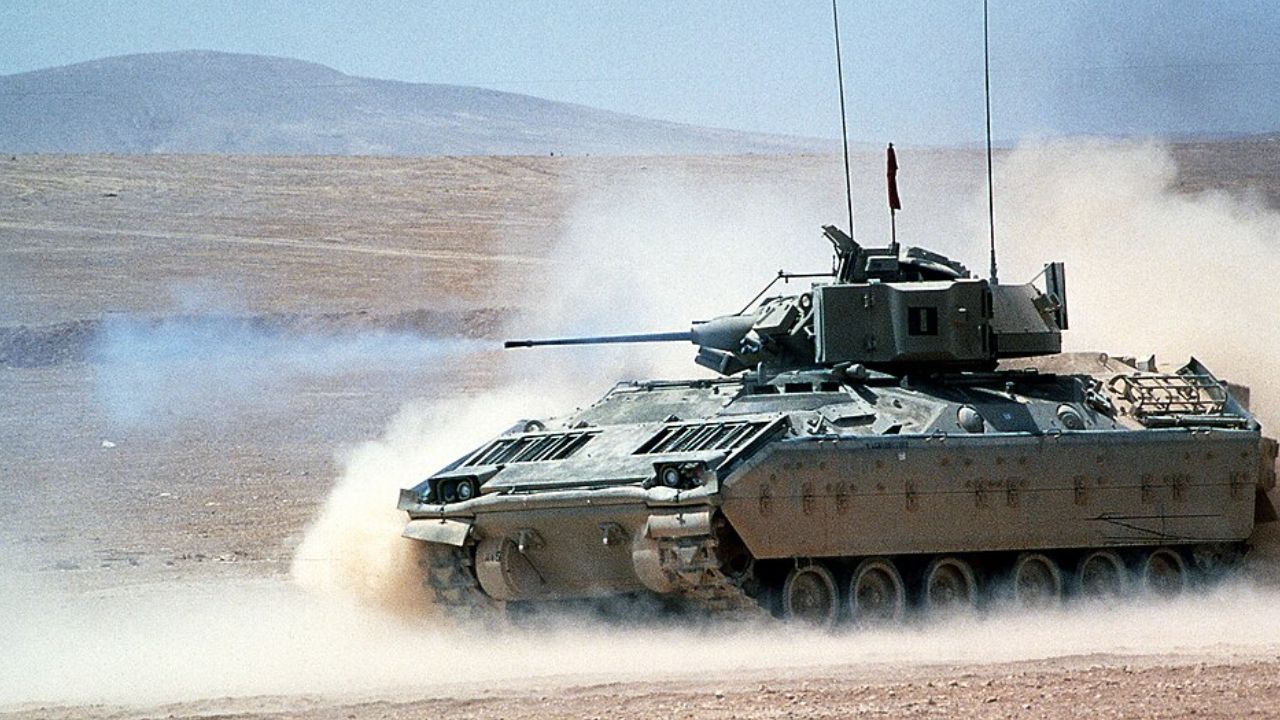
The M2 Bradley Infantry Fighting Vehicle is one of the U.S. Army’s most recognizable Cold War-era platforms—and also one of its most continuously revised. Designed to move with tanks, protect infantry, and contribute real firepower in a mechanized fight, the Bradley has spent decades in the demanding space between an armored personnel carrier and a main battle tank. That in-between role is a major reason it has been debated, upgraded, and kept in service across changing types of war.
The Bradley’s history tracks the evolution of U.S. mechanized doctrine from the late Cold War into major conventional operations and then into counterinsurgency environments shaped by mines and IEDs. It also remains relevant in today’s discussions about how infantry fighting vehicles perform when drones, anti-armor weapons, and widespread surveillance reduce the time between detection and attack.
Why the Bradley existed in the first place
The Bradley emerged from a post-Vietnam U.S. Army that refocused on modern mechanized warfare. Put simply, the Army needed an armored vehicle that could keep pace with tanks, carry infantry who could fight on arrival, and still bring meaningful capability against armored threats typical of Soviet-style formations. That requirement produced the M2 Bradley IFV and the closely related M3 Cavalry Fighting Vehicle, which is optimized for scouting and cavalry missions rather than carrying a full infantry squad.
From the beginning, the program reflected a strategic assumption: U.S. forces would need to maneuver quickly, operate under armor, and fight as an integrated combined-arms team. In that concept, an IFV is not just transportation. It is meant to help units move, see, and fight while reducing exposure to battlefield fire.
Who built it, who fields it, and what it’s meant to do
The Bradley program’s prime contractor was historically FMC Corporation, later United Defense, and now part of BAE Systems. The primary operator is the U.S. Army, with some foreign users as well. The platform’s long production and upgrade history illustrates a common reality in ground combat: major vehicles often remain in service long after the strategic environment that shaped their initial requirements has changed.
Role clarity matters when judging the Bradley. It is not an Abrams, and it is not intended to fight like a main battle tank. The M2’s job is to carry and support infantry in mechanized formations; the M3’s job is to scout, screen, and support cavalry-style missions. Many of the Bradley’s public controversies stem from expecting it to perform like heavier armored vehicles built for different tradeoffs.
The controversies: procurement, testing, and the “perfect vehicle” trap
Debate around the Bradley became well known because it highlighted the basic problem of armored vehicle design: every requirement pushes against another. More protection usually means more weight. More weapons and electronics can reduce space and add complexity. Higher speed and range demand more from engines, fuel, and maintenance. The Bradley became a high-profile example of how difficult it is to balance mobility, firepower, protection, and capacity in a single platform.
Those arguments also played out in disputes over testing and survivability expectations. Over time, the public memory of the era has sometimes turned into simplified narratives. The lasting takeaway is more practical than dramatic: IFVs are built around tradeoffs, and success depends as much on how a vehicle fits into doctrine, training, and support as it does on any single design feature.
Cold War logic, tested in the 1991 Gulf War
For many observers, the Bradley’s early operational reputation was shaped by the 1991 Gulf War. The campaign featured the kind of high-tempo maneuver and large-scale armored operations the U.S. Army had emphasized—rapid movement, long logistics lines, and tight coordination between tanks, IFVs, engineers, artillery, and airpower. In that setting, the Bradley became closely associated with U.S. mechanized units able to move quickly while keeping infantry protected and engaged.
At the same time, it’s easy to draw overly broad conclusions from a single conflict. A more measured reading is that the Bradley, as part of a combined-arms system, supported the Army’s ability to execute its doctrine under the conditions it had prepared for. Its performance was shaped not only by the vehicle itself, but also by training, tactics, maintenance, and the wider advantages available to coalition forces in that campaign.
From deserts to counterinsurgency: adapting to mines and IEDs
Later operations posed a different problem set. In counterinsurgency environments, the most common threats were often mines, roadside bombs, ambushes, and complex attacks rather than massed enemy armor. In those fights, the Bradley’s value often centered on protection, mobility, and the ability to bring controlled firepower and observation to close, fast-changing engagements—while still being maintainable enough to operate continuously over long rotations.
Those years reinforced an important reality for any armored fleet: survivability is not a single attribute. It depends on protection, situational awareness, tactics, route discipline, engineer support, electronic measures, and the speed of casualty evacuation. The Bradley’s evolution reflected that broader system, with upgrades driven by lessons learned and feedback from units in the field.
Modernization as a way of life, not a one-time event
The Bradley’s longevity is inseparable from steady modernization. Over time, the Army pursued upgrade and survivability packages to keep the fleet relevant against changing threats, including anti-tank guided missiles, mines, and—in current discussions—drones and loitering munitions. Because the fleet has existed in multiple configurations and upgrade standards, “the Bradley” is best understood as a family of vehicles rather than a single fixed design.
This approach has benefits and costs. Upgrades can preserve capability faster than replacing an entire fleet, but they require sustained funding, depot and maintenance capacity, spare parts, and training time. As variations accumulate, readiness can become harder to manage because crews and maintainers must keep pace with changes in protection, electronics, and mission equipment.
What today’s battlefield is re-teaching about IFVs
Renewed attention to the Bradley is also tied to wider debates about armored warfare in peer or near-peer conditions. Lessons discussed from modern conflicts—often in the context of Ukraine—underscore how exposed armored vehicles can be when drones, anti-armor weapons, and persistent sensors compress the timeline between detection and strike. That doesn’t make IFVs obsolete, but it raises the demands on camouflage, electronic countermeasures, route planning, air defense support, and combined-arms integration.
The broader point is that performance is context-dependent. The same vehicle can appear resilient in one set of conditions and vulnerable in another depending on terrain, suppression of enemy fires, engineer support, air defense coverage, and crew proficiency. That nuance matters when evaluating what long-serving platforms can still do, and what gaps may require new solutions.
What comes next: replacement debates and force-structure reality
The Bradley’s staying power has made it a reference point in discussions about replacement and next-generation options. The key question is not only what vehicle might be better on paper, but how the Army wants mechanized infantry and cavalry formations to fight in an environment where precision anti-armor weapons and drones are increasingly common. In that sense, the Bradley’s history is also a history of the Army’s ongoing effort to balance protection, deployability, and firepower for troops who have to close with the enemy.
There are also industrial and readiness realities. Keeping the Bradley viable depends on sustained support, supply chains, and the capacity to modernize at scale without reducing unit availability. Whether the fleet transitions to a replacement in phases or continues through further upgrades, the Bradley remains a clear example of how the Army manages risk over time: by evolving a proven vehicle family while adapting doctrine and force structure to meet what comes next.