
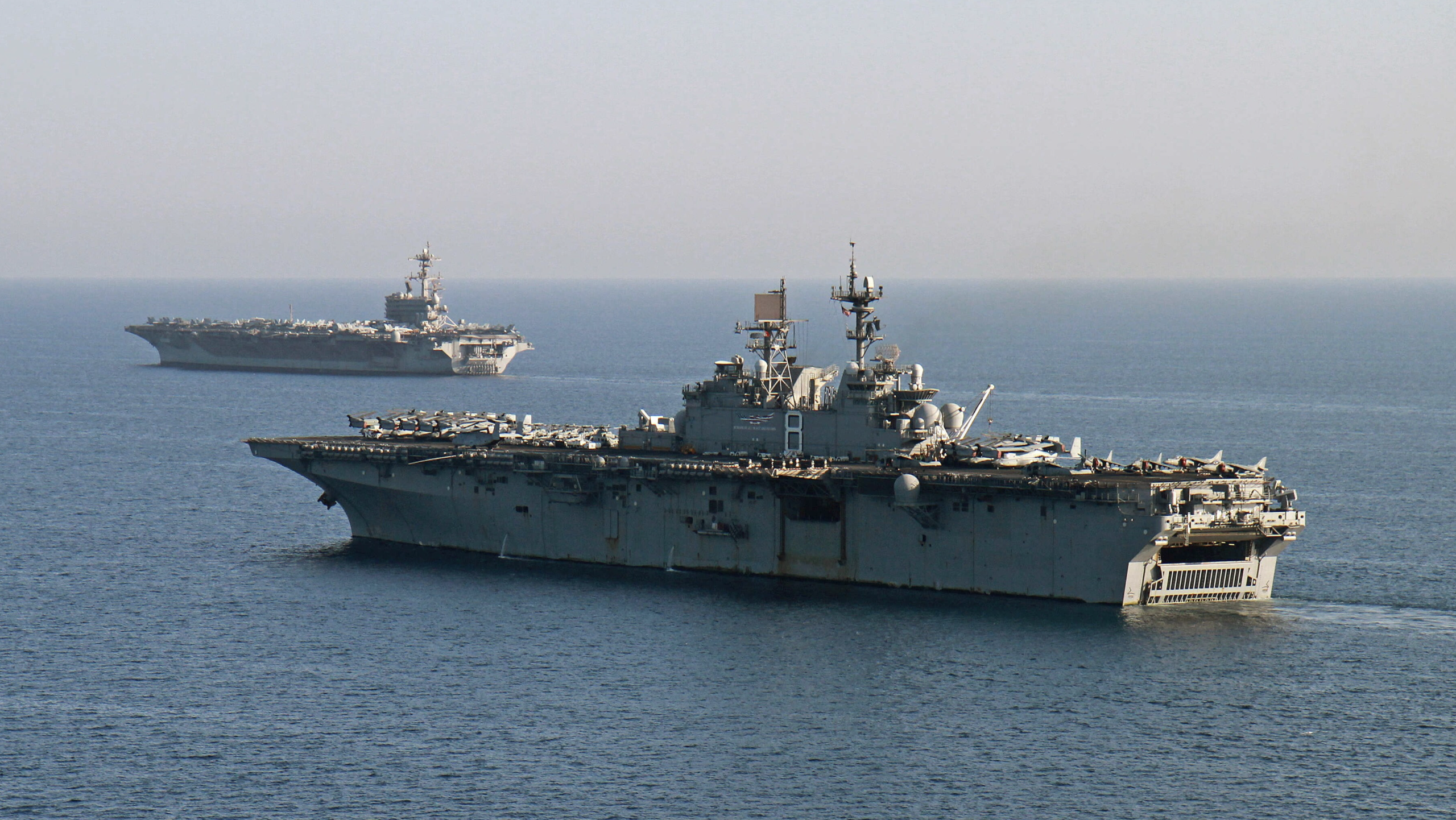
U.S. Central Command said in an X post on June 23, 2026, that two aircraft carriers, the USS George H.W. Bush and USS Abraham Lincoln, continue operating in the Middle East to support freedom of navigation and monitor compliance with the recent agreement with Iran. The command said major U.S. naval assets, including the two carriers, continue operating “in the general area to support freedom of navigation,” adding that “U.S. forces remain present and vigilant to ensure all aspects of the agreement with Iran are adhered to, obeyed, and in full force and effect.” USS Abraham Lincoln, deployed for more than seven months, was conducting flight operations in the CENTCOM area of responsibility as of June 21, while USS George H.W. Bush was last confirmed in the region on June 20.
How the U.S. Built Up to Three Carriers
The current two-carrier posture represents a drawdown from a peak earlier in the conflict, when the U.S. concentrated three aircraft carrier strike groups in the Middle East simultaneously. The arrival of USS George H.W. Bush in the Indian Ocean on April 23 marked the first time in more than two decades that three carriers, USS Gerald R. Ford in the Red Sea, USS Abraham Lincoln in the Arabian Sea, and Bush, had been deployed to the region simultaneously. CENTCOM said at the time it was the most carrier firepower concentrated in the Middle East since the 2003 invasion of Iraq during Operation Iraqi Freedom.
The Bush’s Unusual Route to the Region
The USS George H.W. Bush’s deployment to the Middle East stood out for the unconventional path its strike group took to get there. The Norfolk-based carrier, which departed at the end of March, sailed around the African continent rather than taking the traditional route through the Mediterranean, Suez Canal, and Red Sea. Two defense officials confirmed the carrier and its escorts, including the destroyers USS Donald Cook, USS Mason, and USS Ross, deliberately avoided the Red Sea and the Bab el-Mandeb Strait, where Houthi forces backed by Iran have repeatedly targeted shipping with missiles, drones, and explosive boats since late 2023. No American carrier had attempted to transit the Bab el-Mandeb since USS Dwight D. Eisenhower did so in December 2023, shortly after Houthi attacks on shipping intensified.
The Carriers’ Role in the Blockade
Both Lincoln and Bush played central roles in the U.S. naval blockade of Iranian ports, which began April 13 and continued for roughly two months before being lifted under the terms of the ceasefire agreement. More than 20 U.S. warships, including the two carrier strike groups, were enforcing the blockade by early May, with CENTCOM reporting that forces had redirected 61 commercial vessels and disabled four others attempting to breach it. The Bush, notably, is not equipped with fifth-generation F-35C fighters, unlike the Lincoln, which carries the more advanced aircraft as part of its embarked air wing.
Combat Engagement During the Deployment
The carriers were not merely a deterrent presence; their aircraft saw direct combat during the conflict. According to a detailed timeline of the buildup, a Marine Corps F-35C assigned to Marine Fighter Attack Squadron 314 shot down an Iranian Shahed-139 drone that approached the Abraham Lincoln in the Arabian Sea on February 3, the same day Iranian naval forces attempted to seize the U.S.-flagged tanker MT Stena Imperative in the Strait of Hormuz, prompting the destroyer USS McFaul to escort the vessel to safety.
The Bush’s air wing has also conducted sustained flight operations from the Arabian Sea throughout its deployment. Navy imagery released in early May showed Carrier Air Wing 7 aircraft, including 25 F/A-18E/F Super Hornets, two E-2D Hawkeyes, and three MH-60 Seahawks, arrayed on the Bush’s flight deck during operations in the region.
Why Ford Is No Longer in the Region
The drawdown from three carriers to two reflects the completion of the Gerald R. Ford’s deployment. According to a Navy carrier tracker, the Ford returned to Naval Station Norfolk on May 16 after an 11-month combat deployment spanning the U.S. 2nd, 4th, 5th, and 6th Fleet areas of operations, covering 326 days underway, 57,713 nautical miles, and 23 replenishments at sea. The Ford’s return left Lincoln and Bush as the two carriers remaining in the CENTCOM area of responsibility, the configuration referenced in CENTCOM’s June 23 statement.
What the Carriers Are Doing Now
With major combat operations against Iran concluded and a ceasefire agreement in place, the two remaining carriers have shifted from blockade enforcement and strike operations to a monitoring posture. CENTCOM’s framing of the carriers’ current mission, ensuring the agreement with Iran is “adhered to, obeyed, and in full force and effect,” reflects the broader transition underway in the region following the signing of the 14-point memorandum of understanding between the U.S. and Iran and the subsequent technical negotiations held in Switzerland.
The Abraham Lincoln’s continued presence is notable given the length of its deployment. Having entered the CENTCOM area of responsibility on January 26 after departing San Diego the previous November, Lincoln has now been deployed for more than seven months, a deployment length that exceeds typical Navy carrier rotation schedules and reflects the sustained demand for carrier presence in the region throughout the conflict and its aftermath.
Other Naval Assets in the Region
Beyond the two carriers, the broader U.S. naval presence built up during the conflict has included multiple amphibious ready groups and independently deployed destroyers. The Tripoli Amphibious Ready Group, carrying the 31st Marine Expeditionary Unit, supported blockade operations alongside the carriers, including boarding and seizing the Iranian-flagged vessel M/V Touska in April after the destroyer USS Spruance fired on and disabled the ship’s engine room. The Boxer Amphibious Ready Group, carrying the 11th Marine Expeditionary Unit and roughly 5,000 additional Marines and sailors, also arrived in the region in May to reinforce the Tripoli group’s expeditionary capabilities.
Continued Tensions Despite the Agreement
The continued carrier presence comes as the underlying agreement has shown signs of strain. Iran threatened over the preceding weekend to close the Strait of Hormuz again, citing what it described as Israeli violations of the broader regional ceasefire in Lebanon, even though the strait had reopened to commercial shipping earlier in the month under the terms of the memorandum. U.S. officials disputed that the strait had actually closed, citing continued vessel transits, even as the dispute illustrated the fragility of the broader arrangement the two carriers remain positioned to help enforce.
Neither CENTCOM nor the Navy has indicated a timeline for when Lincoln or Bush might be relieved or return to their home ports, with both carriers continuing routine flight operations in the region as of the most recent confirmed sightings in late June.