
The U.S. Navy’s carrier air wing is entering a decade in which range, survivability, and sustained sortie generation matter as much as raw striking power. The modernization story is not a clean swap of one “classic” air wing for an entirely new one. It is more likely to be a gradual shift toward a hybrid mix of legacy manned aircraft, fifth-generation fighters, and unmanned systems that take on enabling tasks the air wing depends on to fight at distance. Public discussion of a “hybrid air wing” reflects that reality: the carrier has to keep its strike and air defense punch while adapting to modern long-range surveillance, anti-ship threats, and integrated air defenses.
In practical terms, the next decade could be defined by how quickly the Navy turns today’s manned-heavy lineup into a manned-unmanned team model that works on the flight deck as well as it does in concept slides. The likely building blocks are already visible: F-35C (with Marine Corps F-35B integration shaping the wider naval aviation ecosystem), continued F/A-18E/F Super Hornet sustainment and upgrades, the E-2D Hawkeye as the airborne command-and-control backbone, and MQ-25 Stingray to restore organic tanking. Alongside those nearer-term efforts is the still-fluid “next fighter” discussion often framed as NGAD / F/A-XX. The big change is not a “pilotless air wing,” but a reshaping of roles so unmanned aircraft can shoulder tanking and other enabling missions—potentially including ISR, communications relay, and decoying—while manned aircraft concentrate on the most complex tactical decisions and weapons employment.
From strike packages to a more networked air wing
For decades, carrier aviation built manned strike packages: fighters, electronic attack, airborne early warning, and tanking combined to push power inland. That approach still underpins how carriers fight, but it is increasingly constrained by distance and by the need to operate under persistent surveillance and long-range threats—especially in the Indo-Pacific. The direction of travel is to treat the air wing less as a set of separate squadrons and more as a connected system that can distribute sensing, extend reach, and manage risk under pressure.
That is where manned-unmanned teaming becomes a practical goal rather than a slogan. If unmanned platforms can reliably provide fuel, extend communications, or gather ISR, fewer manned sorties have to be diverted into support roles. In contested environments, those “support” tasks can become decisive because they determine whether strike and air-defense aircraft arrive with enough fuel, awareness, and connectivity to fight.
MQ-25: a tanker that could change how the air wing uses its fighters
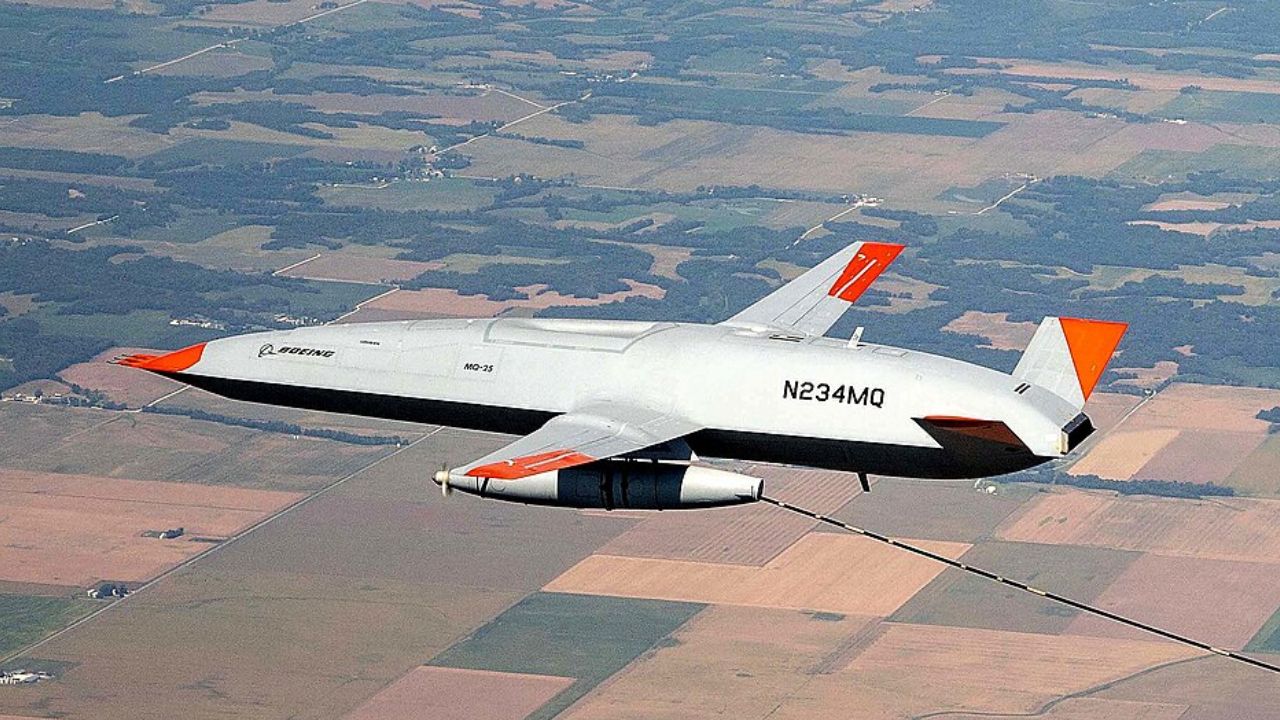
The MQ-25 Stingray is the clearest near-term shift because it targets a straightforward operational problem: the air wing needs organic tanking to reach useful distances without consuming strike-fighter flight hours and service life on routine refueling missions. An unmanned tanker is intended to restore that capacity while easing wear on the manned strike-fighter inventory.
MQ-25 also highlights the trade-offs the Navy has to manage when it brings unmanned aircraft into regular carrier operations. Integrating a UAV into deck cycles affects deck handling, maintenance practices, safety procedures, and training pipelines. It also introduces vulnerability concerns around data links and resilience in electronic-warfare environments. If integration goes well, the payoff is more flexibility in how far the carrier can stand off while still generating sorties with meaningful persistence.
F-35C and the network question
F-35C modernization pressure is not only about adding another fighter type; it is also about adding a platform designed to operate in contested environments with a strong emphasis on sensing and data-sharing. As the F-35C mix grows, the air wing’s “center of gravity” can shift toward distributed sensing and sensor fusion, with aircraft sharing information more effectively than older formations typically could. That pushes a broader question across the air wing: which functions still require dedicated platforms doing dedicated jobs, and which functions can be supported by a more networked approach?
This debate sits at the heart of hybrid air wing concepts. Fifth-generation sensing and networking may change how targeting support and ISR are collected and distributed, but it does not remove the need to plan for degraded communications and electronic attack. A more connected force also needs to be able to keep fighting when that connectivity is disrupted.
Super Hornet sustainment: keeping capacity while the next pieces arrive
The F/A-18E/F Super Hornet remains central because it is the workhorse that fills flight decks today. Sustaining it—and continuing upgrades and readiness investments—buys time while MQ-25 is integrated and the Navy works through decisions about the next generation of carrier-based fighters. In budget terms, sustainment is also risk management: modernization cannot succeed if readiness erodes faster than new capability appears.
Industrial reality shapes the mix as well. Boeing spans both the Super Hornet/Growler family and MQ-25, while Lockheed Martin’s F-35 line represents the fifth-generation pillar. Northrop Grumman’s E-2D Hawkeye remains a core enabler for airborne command and control, and the company is frequently discussed in public reporting as a potential participant in future air dominance efforts—even as NGAD/F/A-XX ownership, schedule, and funding remain politically and budgetarily sensitive.
E-2D Hawkeye: managing complexity in the air
In a future air wing, the E-2D Hawkeye remains the “glue” that helps a complex package function—particularly when the air picture is crowded and communications are contested. As the air wing adds unmanned aircraft, the demand for airborne battle management does not necessarily shrink; it can grow as more nodes, tracks, and mission threads have to be coordinated while the ship maintains an efficient deck-to-sky rhythm.
This is why modernization is not just about buying airframes. Adding MQ-25, expanding F-35C operations, and sustaining Super Hornets all place different demands on planning, airborne control, and shipboard workflow. A more networked air wing can be more capable, but it is also more interdependent—and that makes integration and training as important as procurement.
What NGAD / F/A-XX could mean—and what it may not
Discussion of a next-generation fighter, often framed as NGAD or F/A-XX, sits at the edge of what can be said with confidence because program labels, timelines, and funding profiles remain fluid. The case for a new platform is generally tied to the same drivers shaping the rest of carrier aviation: range, survivability, and the ability to operate against advanced air defenses while keeping the carrier relevant. The counter-argument is equally direct: if Super Hornets can be sustained and upgraded, and if the air wing gains meaningful reach through organic tanking and improved networking, the Navy may choose to delay the most expensive leap while requirements and budgets settle.
Either way, the next decade is likely to be shaped more by systems integration than by any single aircraft announcement. If a future fighter arrives, it is likely to be expected to operate as part of a broader set of manned and unmanned capabilities rather than as a standalone replacement. It is premature to treat NGAD/F/A-XX as a certain, near-term transition on the model of past fighter replacements.
Deckplate realities: sortie generation, manpower, and new failure modes
Carrier air wings ultimately succeed or fail on deck cycles, maintenance hours, and training pipelines. Unmanned aircraft may reduce risk to pilots in certain mission sets and could shift how manned flight hours are allocated, but they also bring software-driven maintenance rhythms and new troubleshooting demands. A hybrid air wing has to demonstrate that it can increase persistence or improve sortie generation without becoming brittle due to link dependencies or cyber and electronic-warfare vulnerabilities.
There is also a practical safety and tempo challenge. Integrating unmanned operations on crowded flight decks requires procedures that protect crews while sustaining launch-and-recovery pace, including at night and in difficult sea states. Even if unmanned systems expand beyond tanking into ISR, communications relay, or decoying roles, early measures of success will be basic but decisive: predictable reliability, safe handling, and consistent turnaround times.
Why it matters: standoff distance is becoming a combat variable
The strategic driver behind these changes is simple: potential adversaries are extending how far they can detect and threaten high-value naval forces, and carriers have to keep projecting power without operating unnecessarily close to that threat. Extending the air wing’s reach with organic tanking, distributed sensing, and more resilient networking supports operations from greater standoff—an especially relevant consideration in the Indo-Pacific. A carrier that can stay farther out and still generate effective combat sorties complicates an adversary’s planning and reduces operational risk.
This logic also matters beyond the Pacific. In NATO and expeditionary contexts, tanking, ISR, and electronic warfare are consistently in demand. An air wing that can provide more enabling capability organically is more flexible, but modernization competes with other Navy priorities, from submarines and surface combatants to munitions and shipbuilding. That means the path forward will be shaped by trade-offs, not just operational preference.
The most plausible picture of the next decade is a carrier air wing that still looks familiar from a distance—fighters, airborne early warning, and support aviation—but behaves differently in combat. The shift is toward a hybrid force where unmanned platforms take on enabling roles at scale, manned aircraft focus on the most demanding tactical problems, and the air wing functions as a resilient network designed for contested environments. Whether that produces real gains in effective reach or adds complexity without payoff will depend less on any single airframe and more on integration, training, and the Navy’s ability to fund readiness while it modernizes.