
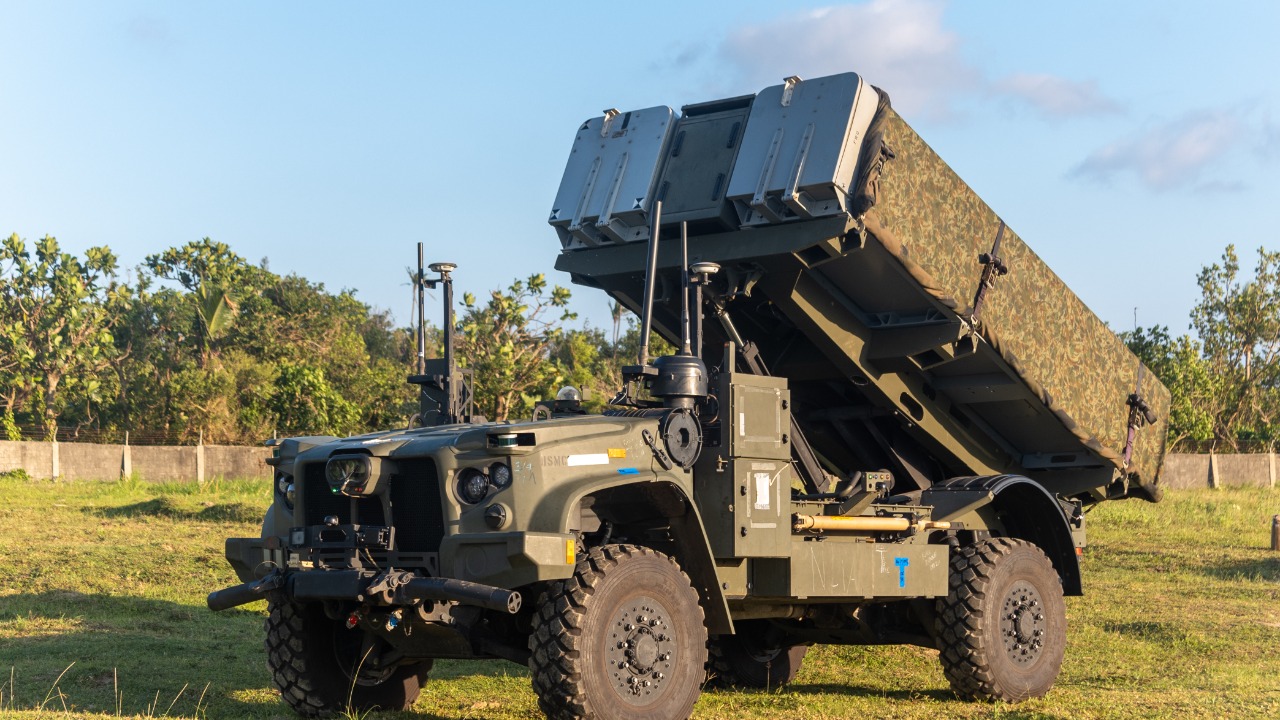
The U.S. Marine Corps is turning to commercial self‑driving expertise to push its unmanned rocket launchers further from the front line. By bringing Kodiak AI’s autonomous trucking technology onto the ROGUE-Fires launcher platform, the service is testing whether software that already moves Class 8 trucks on highways can also steer heavy weapons carriers through contested terrain. The experiment could reshape how Marines move long‑range missiles without exposing drivers to the same level of risk.
Rather than treating autonomy as a futuristic add‑on, the Marine Corps is inserting it directly into a fielded launcher concept tied to systems such as the Navy Marine Expeditionary Ship Interdiction System, or NMESIS. Under the approach, the vehicle drives itself while Marines retain control of targeting and firing decisions, blending automation with human command. How that balance works in practice will determine whether this technology remains a niche demonstration or becomes a core feature of future Marine firepower.
Why the Marine Corps wants driverless ROGUE-Fires
The Marine Corps has been clear that ROGUE-Fires is about moving missiles into position without putting a Marine behind the wheel. The launcher is built to carry weapons such as the Naval Strike Missile on a remote, unmanned chassis that can disperse across islands or coastal areas while operators remain under cover. By adding a mature autonomous driving system, the service aims to extend that concept so the vehicle can navigate to firing points, reposition after launches, and support resupply runs without a crew in the cab.
Officials turned to Kodiak AI because the company already fields an autonomous driving stack for heavy trucks, branded as Kodiak Driver, that is designed to handle long distances and complex road conditions. The Marine Corps awarded a contract that directs the company to integrate this software into the ROGUE-Fires platform, so the launcher can operate as a driverless ground vehicle under Marine control, rather than as a teleoperated robot that needs constant joystick input. That contract, described in driverless tech, frames autonomy as a way to increase operational reach and reduce exposure for Marines who would otherwise have to drive within range of enemy fire.
How Kodiak Driver is being adapted for ROGUE-Fires
Kodiak AI is not building a new robot from scratch for the Marines; it is porting its existing Kodiak Driver system onto a military vehicle that must survive rough terrain and potential combat damage. The company has said it will integrate its AI into the ROGUE-Fires chassis so the vehicle can plan routes, avoid obstacles, and handle unstructured environments that look nothing like interstate highways. According to a company announcement on a Marine Corps Awards page, Kodiak will focus on autonomy for ground movement, with the system intended to support high‑end expeditionary missions while Marines retain authority over the weapons themselves.
Adapting commercial self‑driving software to military needs also means teaching it to cope with dust, mud, and the absence of clear lane markings. Reporting on the award notes that Kodiak AI and the Marine Corps expect the technology to operate in unstructured and unmapped environments, a far cry from the mapped freight corridors where many autonomous trucks run today. One account of the deal explains that Kodiak AI has described the project as a path to create autonomous vehicles for the Marine Corps that can function when GPS is degraded, and roads are little more than tracks, with Kodiak AI emphasizing performance in unstructured and unmapped environments.
The industrial team behind the launcher
Behind the scenes, the ROGUE-Fires vehicle itself is the product of a separate effort to adapt proven truck designs for remote weapons use. The Marine Corps previously selected Oshkosh Defense for the Rogue Fires vehicle, with a nearly 30 million dollar award to develop the unmanned launcher chassis. In a presentation on the program, Oshkosh leaders described how they are leveraging existing vehicle families to carry missile payloads, an approach captured in a statement that begins with “As the battlefield continues to evolve” and goes on to link Oshkosh’s commercial platforms to the ROGUE-Fires concept.
Video briefings on the system have highlighted that the Marine Corps views ROGUE-Fires as a core future weapon, pointing to the contract with Oshkosh Defense for Fires as a sign of that commitment. In parallel, the service has tested the Navy Marine Expeditionary Ship Interdiction System, or NMESIS, which uses a similar unmanned truck to fire Naval Strike Missiles from shore. Reporting on the new autonomy effort notes that the same basic launcher concept that underpins NMESIS will now host Kodiak Driver, allowing a single architecture to support both ship‑killing missions and future long‑range fires once the driverless technology is proven.
What the Marines hope to learn from the trials
Marine leaders are not only trying to prove that a ROGUE-Fires launcher can steer itself; they also want to understand how autonomy changes tactics. Company statements say the integration will help the Marine Corps assess how autonomous capabilities affect operational reach, mission flexibility, and expeditionary force projection. One description of the project explains that the service will use the trials to measure how far an unmanned launcher with Kodiak Driver can travel and reposition compared with a human‑driven truck, and how that affects the survivability of Marines who would otherwise have to crew the vehicle in contested areas, an aim highlighted in a Marine Corps-focused summary.
The company has also framed the ROGUE-Fires work as a way for the Marine Corps to explore how commercial autonomy can plug into multiple platforms. One report notes that the service tapped Kodiak AI to install its system on ROGUE-Fires and related launchers such as NMESIS, to create a common autonomy kit that can move different missile carriers. Another account explains that the integration effort will help the Marine Corps evaluate how driverless launchers affect risk to personnel operating in contested areas, a point echoed in a U.S. Marines integration summary. Kodiak AI itself has said that its work under the Marine Corps award is intended to support high‑end expeditionary missions where keeping Marines away from exposed driving positions is a central requirement.